
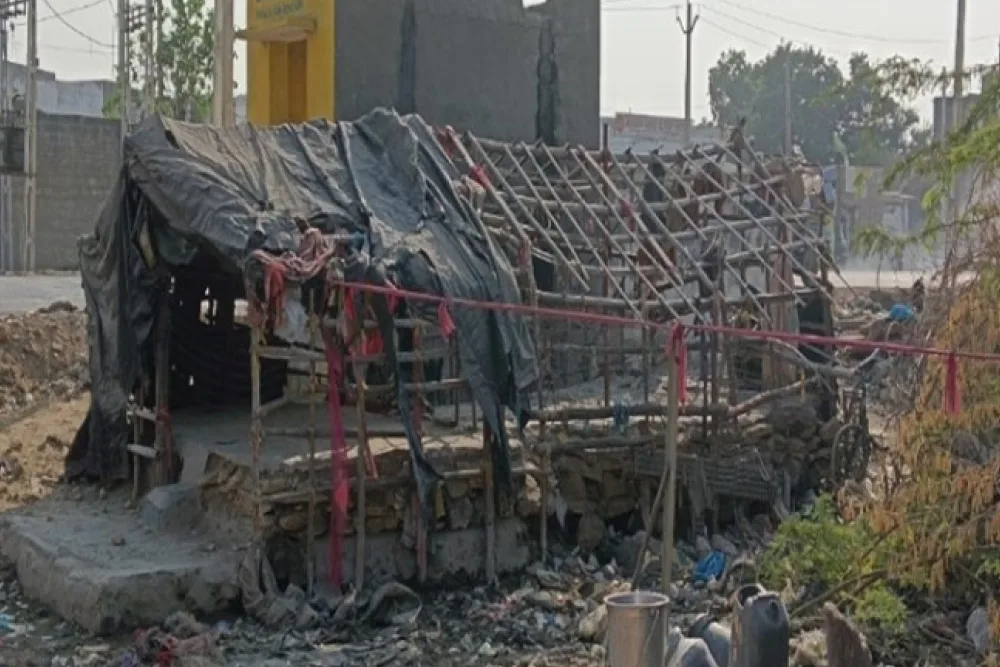
In the remote village of Surajkaradi, nestled near Madhuram, education wasn’t just absent, it was almost invisible. Children from the Devipujak community, a socially marginalized and economically disadvantaged group, had little exposure to formal education. Many had never stepped into a classroom, and those who had often dropped out due to irregular attendance and lack of interest.
This was not due to indifference, but intersecting barriers of social exclusion, migration, and infrastructural neglect. In such a fragile ecosystem, change had to be rooted in empathy, inclusion, and community ownership.
The First Spark: Volunteer-Led Learning Begins
To address this gap, a volunteer-led learning initiative was launched to offer children a chance to learn in a safe, friendly environment. But the path was far from easy. There was no shelter or seating, making it impossible to conduct classes during rain, heat, or cold. What was meant to be a consistent space of learning was becoming an irregular patch of effort—vulnerable to the elements, and to being forgotten.
Collective Will, Collective Action
Enter Deepakbhai, an active School Management Committee (SMC) member from Surajkaradi Kanya Shala. Rather than accept the limitations, he rallied the community. He went door to door, initiated conversations with parents, and called a village meeting to discuss the urgent need for a proper space for learning.
This wasn’t a top-down intervention, it was people-powered change. Parents, despite limited means, pooled small donations. Contributions came in many forms,not just money, but time, labor, and belief. With these resources, materials like bamboo, tarp sheets, and ropes were procured. Deepakbhai, along with Papubhai, a local parent, led the construction of a modest yet sturdy hut, one that now stands as a beacon of transformation.
From Dropouts to Regular Students: A Transformation in Numbers and Spirit
- 16 children (9 boys and 7 girls), once disengaged from formal learning, are now regular schoolgoers.
- The volunteer teacher, Radhu Ben from Mithapur, now teaches in a space that’s safe, quiet, and respected by the community.
- Children who once wandered the village have begun to read, write, and dream.
This change wasn’t just physical—it was psychological and social. The presence of a stable learning space helped children see themselves as learners. Parents saw value in education because they had helped build its foundation—quite literally.
The Bigger Picture: Community-Led Education
This story is a shining example of what happens when communities are treated not as beneficiaries, but as partners. The role of the SMC in catalyzing this transformation highlights the importance of decentralization, local leadership, and participatory governance in education reform.
This modest hut is a symbol, A symbol that says education doesn’t always need grandeur, it needs commitment. It proves that empowerment begins with inclusion, and that with the right support, even the most vulnerable communities can build bridges to a better future.