
Introduction:
Mathavada a coastal village, located in the Talaja Block of Bhavnagar District, has long faced the challenges of erratic rainfall and an over-reliance on groundwater for irrigation and daily needs. With a population of 3,349 and 554 households, the village sustains itself through farming and animal husbandry, with 291 farmers and a significant livestock population of 1,617 cattle. Over the years, the excessive withdrawal of groundwater and lack of perennial rivers made the village highly vulnerable to seawater intrusion, negatively affecting its water quality and overall livelihood security. However, through the targeted interventions of CSPC, Mathavada has seen a transformation in its water resource management, access to safe drinking water, agricultural practices, and overall well-being.
The Challenge:
Before CSPC’s intervention, Mathavada’s only source of drinking water was the Jalumb Well, with a Total Dissolved Solids (TDS) reading of ~800 PPM —indicating unsafe drinking water quality. The village also relied on 5-6 hand pumps for domestic water usage, which were inadequate given the growing needs of the population. Water scarcity was a constant threat, exacerbated by over-extraction of groundwater and poor irrigation methods. Most of the village’s population, especially small and marginal farmers, faced deteriorating soil quality, lower crop yields, and limited water availability for livestock.
CSPC’s Intervention:
Understanding the village’s critical water needs, CSPC stepped in with a comprehensive strategy that not only focused on water resource management but also incorporated social and behaviour change principles to promote long-term sustainability.
- Water Resource Management:
- Source Strengthening: CSPC carried out source strengthening of the Jalumb Well, which improved the water supply for the community. Additionally, a recharge tubewell, 4 well recharge, and 2 check dams were repaired, and major desilting was also undertaken to improve the water storage capacity and thereby enhance the groundwater potential –
Photograph of the Common Well developed as a secondary source
- Water Quality Improvement: To assure the quality of the tap water being supplied, CSPC installed an in-line chlorinator in the village’s water supply system under the JJM program supported by the state government. This ensured the water was purified before reaching households. A sensor-based pumping machine was also installed to enhance operational efficiency and reduce water wastage.
Photograph of the Inline Cholorinator unit
- Efficient Irrigation Practices: Recognizing the importance of sustainable agriculture, CSPC introduced the concept of micro-irrigation techniques such as drip irrigation, laser irrigation, and water metering demonstrations. These methods helped the farmers reduce water wastage and adopt more efficient irrigation systems for crops like groundnut, cotton, onion, wheat, and fodder. Demonstrating the benefits of these irrigation techniques motivated farmers to shift from traditional to modern methods, ultimately leading to better yields and water conservation.
- Social and Behaviour Change Communication (SBCC): CSPC’s approach wasn’t limited to infrastructure development but also integrated social and behavior change principles to ensure community participation and ownership of the interventions.
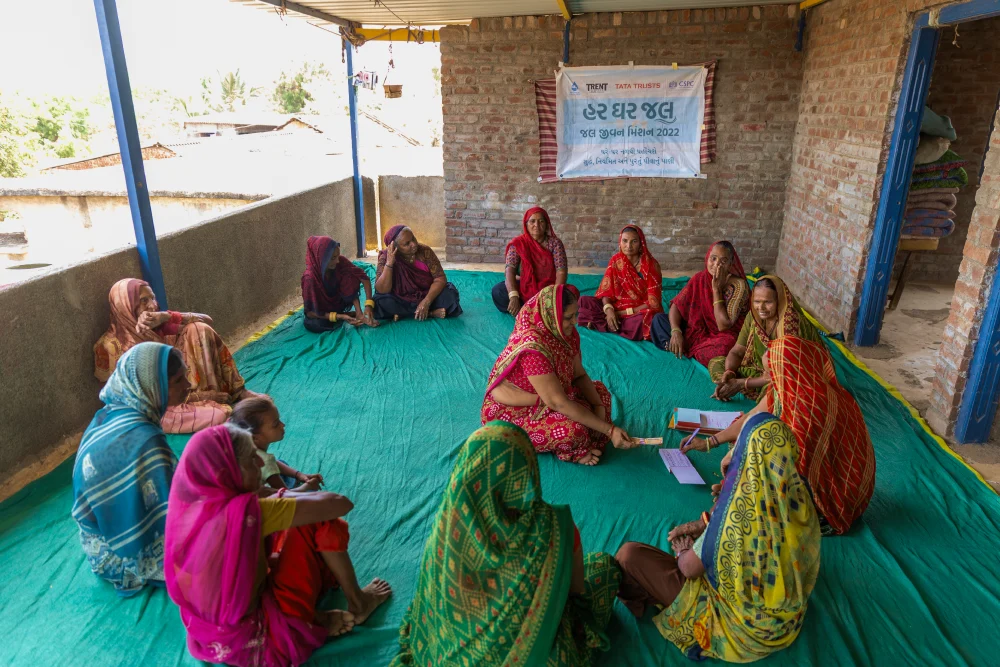
- Community Engagement: Through extensive workshops and training sessions, CSPC educated the villagers on the importance of water conservation, water quality management, and efficient management of water resources.
The Other interventions included:
- Installation of household tap connections under the government supported flagship scheme of JJM – Har Ghar Nal Se Jal: With 504 functional household tap connections, access to safe drinking water became more reliable and assured, reducing the time and effort spent by women and children on fetching water.
- Sanitation Awareness Campaigns: CSPC conducted awareness sessions to educate villagers about the importance of hygiene and safe water practices, including the need for household water treatment and storage.
- Menstrual Hygiene Promotion: The organization introduced menstrual hygiene-related behaviour change communication campaigns to educate women and adolescent girls on the importance of proper menstrual hygiene management, especially for the well-being of young girls and vulnerable groups. These campaigns emphasized safe practices, the use of hygienic products, and the importance of clean sanitation facilities to promote health and dignity.
Conclusion: The transformation of Mathavada Village is a testament to CSPC’s holistic approach, which goes beyond infrastructure development to include social and behaviour change, community engagement, and long-term sustainability. By addressing the village’s water scarcity issues, promoting efficient irrigation, and encouraging sustainable livelihood practices, CSPC has created a model for community led water resource management that can be replicated in other coastal villages facing similar challenges. The success of Mathavada’s journey highlights the importance of community ownership, behavioural shifts, and innovative interventions in tackling the pressing issue of water security in Gujarat’s coastal regions.