
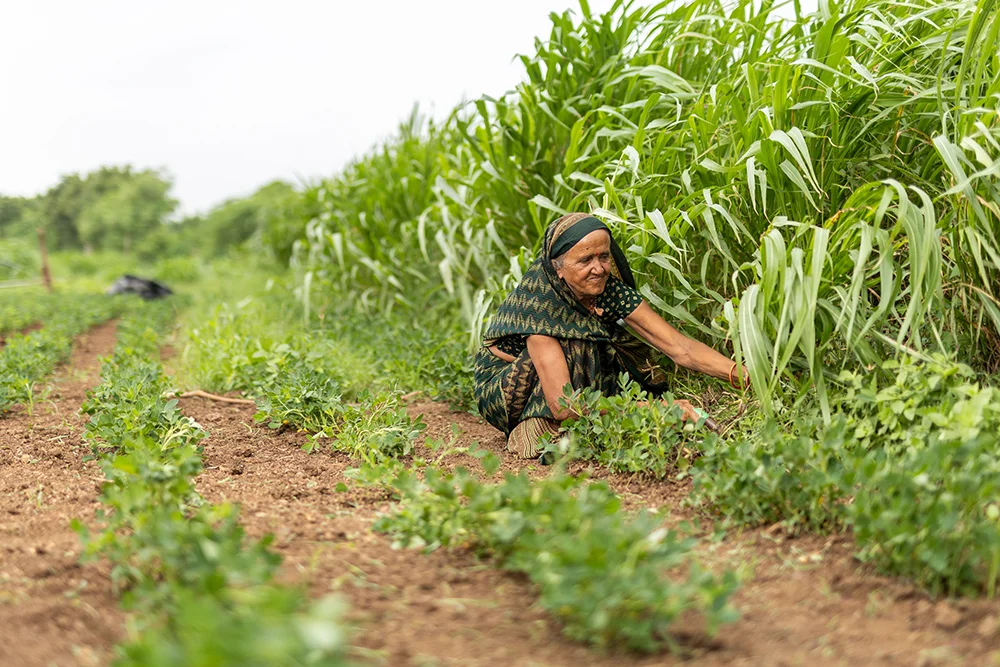
In the quiet village of Mathavada in Talaja, Dhudiben Kanabhai Makwana’s three acres of scattered farmland had long been a place of hard work but dwindling returns. For years, she and her family of eight wrestled with the same cycle: cooking on smoke-filled clay stoves that left eyes burning and pots blackened, spending hours collecting firewood, paying heavily for diesel to run the irrigation pump, and watching the soil lose its richness under the weight of chemical fertilizers. Summers were the hardest—when water ran short, the fields would stand dry, and the family would migrate to nearby towns in search of work.
The turning point came when the CSPC, with support from Tata Trusts under the Sustain Plus initiative, introduced her to two sustainable solutions, each promising to ease a different burden but together transforming her way of life. The first was a biogas digester, a small dome-like structure tucked away on her farm, powered entirely by cow dung from her 11 cattle. It replaced the smoky kitchen fire with a clean, steady flame, and the nutrient-rich slurry it produced became a natural fertilizer for her crops. No longer did Dhudiben need to spend on chemical fertilizers or buy fodder from the market; the fields themselves began to produce healthier forage for her livestock.
The second change arrived in the form of a solar-powered lift irrigation system, a quiet, glinting set of panels that replaced her costly diesel pump. With it came freedom from the ₹100-an-hour fuel bills and the constant worry of whether she could afford to irrigate her fields. The sun now powered her water supply, and for the first time, Dhudiben could plan crops for the summer months without fear of the wells running dry.
The difference on the farm was visible within a season. The soil, enriched by slurry, began to breathe again. Groundnut, pearl millet, lucerne, COFS29, and even horticultural saplings thrived without the chemical inputs of the past. The kitchen was free from soot, the family was eating homegrown vegetables, and the livestock were healthier than ever. Financially, the savings were substantial—reduced LPG use alone saved her ₹6,000 a year, while eliminating chemical fertilizers and outside fodder purchases saved another ₹13,500. Add to that the removal of diesel costs and the improved yields, and Dhudiben found herself keeping nearly ₹60,000 more in her pocket annually.
Beyond numbers, the changes gave Dhudiben something harder to measure: control over her livelihood. No longer bound by seasonal migration, she could tend her fields year-round. She is already planning to expand organic vegetable cultivation on one acre, confident that her water and soil will support the effort. Her success has not gone unnoticed—neighbours have begun to ask about biogas systems and solar pumps, and some are taking steps to adopt them.
From smoke-filled kitchens and parched fields to clean energy and thriving crops, Dhudiben’s journey is a testament to how simple, well-chosen innovations can turn survival into security. In her words, “Now the sun gives me water, the soil gives me food, and my home is full of fresh air.”