
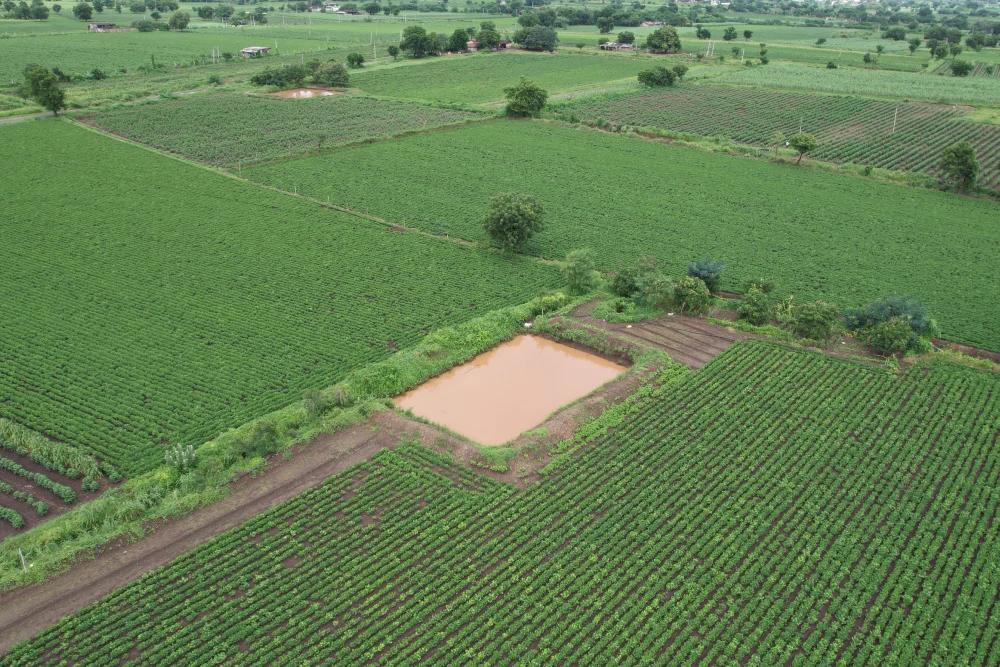
Navi Chhapari, a small village in Talaja taluka, is perched on the ridge of a watershed. Here, rainwater doesn’t linger, it rushes away, leaving the earth thirsty and the wells shallow. For 35-year-old Bhammar Lakshmanbhai Balabhai, this meant a frustrating paradox: fertile land and a good climate, but too little water to grow high-value crops. His four hectares could only sustain cotton, groundnut, and some fodder; onions were a gamble, and summer crops were almost impossible.
When CSPC, with support from HDFC, proposed the construction of a farm pond, Lakshmanbhai saw a chance to store the very thing that always slipped away. The pond, measuring 70 by 70 feet and 5 feet deep, could hold nearly 694 cubic meters of water. Built at a shared cost, half from him, half as a subsidy, it became a reservoir not just for irrigation but for hope.
The first year proved its worth. The pond held enough water to irrigate beyond the monsoon, allowing Lakshmanbhai to plant more intensively and with greater confidence. The silt removed during excavation was spread across his fields, boosting soil fertility and yields. His well’s water level rose by about 15 feet, and the overall groundwater table in the area saw an average increase of 5%. Cropping intensity grew by 10%, and his annual income jumped by ₹80,000.
Today, the pond reflects a shift from dependence on the rains to control over the seasons. For Lakshmanbhai, it has turned farming from a gamble into a more secure livelihood, proving that sometimes a simple storage of water can be the most powerful harvest of all.